Dynamic QR Codes: How They Work & When You Need One
The redirect architecture in detail, what you gain and what you take on, the dependency question nobody prices in, and how to decide between static and dynamic for a specific job.
Guide
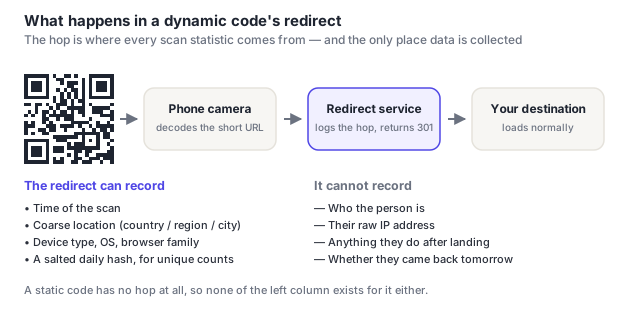
Everything on this page follows from one architectural fact: a dynamic QR code puts a server between the scan and the destination. That single hop is what makes codes editable, what makes analytics possible, what creates a privacy obligation, what an API can operate on, and what an attacker can impersonate. Understand the hop and the rest of this section is downstream of it.
A static QR code contains your destination. Scanning it is a purely local act. The phone decodes the pattern and opens what's written there. No server is involved, nothing is recorded anywhere, and the code will keep working for as long as the destination does.
A dynamic code contains a short URL belonging to a redirect service. Scanning it makes a request to that service, which records the hop and answers with a redirect to wherever you've currently pointed it.
Four consequences, each of which gets its own page in this section:
That last one deserves more weight than it usually gets. A static code printed in 2015 still works today. A dynamic code works as long as somebody keeps paying for and operating a redirect service. Which, over the ten-year life of a printed sign, is a real assumption.
Scan analytics are genuinely useful and routinely over-read. The hop can record when a request arrived, roughly where from, and what kind of device made it. It cannot tell you who anyone is, whether they did anything afterwards, or whether the same person came back next week.
The most common confusion is the gap between scan counts and web analytics:
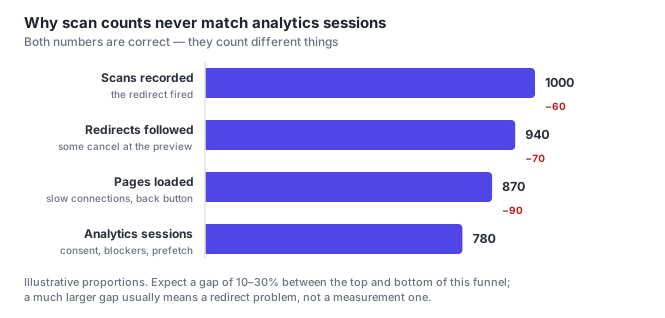
A 10–30% gap between the top and bottom of that funnel is normal. A much larger one usually means something is wrong with the redirect rather than with the measurement.
What scan analytics can and can't tell you → · Connecting scans to Google Analytics →
The moment you put a dynamic code on something, a log of scan events starts accumulating: timestamps, coarse locations, device types. Under GDPR and similar regimes that is personal data being processed, and you are the one deciding why. That makes you a controller, with the duties that follow.
This is not usually onerous, and it's rarely a reason to avoid dynamic codes. But it is a set of questions with real answers: what's collected, how long it's kept, what your privacy notice says, and whether your provider will tell you any of that. A surprising number won't.
Do they store raw IP addresses? For how long? Is scan data deleted when a code is? Where is it processed? Those four questions separate providers who have thought about this from providers who haven't, and the answers belong in your privacy notice rather than in a support ticket.
Everything above assumes a handful of codes made by hand. Past a few dozen (a code per product, per property, per table, per campaign) the constraint stops being design and starts being operations: creating them in bulk, keeping records of which code is on what, and repointing them without clicking through a UI a thousand times.
That's an API problem. It's also where the interesting failure modes live: partial batch failures, keys with the wrong scope, rate limits hit during an import, and the reconciliation question of which physical object carries which code.
QR codes carry text, and text doesn't execute. So the code itself is never the threat. The risk is entirely about destination and trust:
Practically, it's whether a server sits between the scan and the destination. Static codes are self-contained and behave like printed text. Dynamic codes route through a redirect, and that single architectural difference is what creates editability, analytics, a privacy obligation, an API surface and a class of security risk. Everything in this section follows from that hop existing.
If the code is printed in volume, tied to a campaign, or needs measuring, yes, being able to fix a wrong destination without a reprint is worth the dependency on its own. If it's self-contained data that will never change, like a Wi-Fi password or an asset tag, a static code is simpler, free, works offline and can never be switched off by someone else.
A dynamic code records the hop whether or not the person notices, which is exactly why it carries a disclosure obligation rather than a technical one. The data is coarse (time, approximate location, device type) and doesn't identify anyone by itself. But "they didn't notice" is not a legal basis, and if you use dynamic codes your privacy notice should say so.
Dynamic codes stop resolving, and there's no way to fix printed material. This is the single largest risk of dynamic codes and it's rarely priced in when choosing a provider. Mitigations: prefer providers who let you export your code-to-destination mapping, consider a redirect on your own domain so you keep control of the short URL, and use static codes for anything that must survive independently.
The redirect architecture in detail, what you gain and what you take on, the dependency question nobody prices in, and how to decide between static and dynamic for a specific job.
Every field a scan can produce, what each one is actually worth, the four questions scan data cannot answer, and how to design a code scheme that measures something useful.
UTM parameters that survive a redirect, why scan counts and GA sessions never agree, how to attribute offline placements, and the consent problem in the middle of it.
When scan tracking becomes personal data, what to put in a privacy notice, retention and deletion, and the four questions worth asking any provider before you depend on them.
When to stop clicking and start scripting: batch creation, all-or-nothing semantics, key scoping, rate limits, CSV export, and keeping track of which code is on which object.
Why a code can't carry a virus, how quishing actually works, what to check before tapping, and how to protect codes you've published into the world.
Range, cost, hardware support and durability compared honestly, including the cases where NFC genuinely wins and the ones where using both is the right answer.